-
70%
-
51%
-
15%
-
80%2 Litres a Minute Flow Limiter for Bristan Taps $ 17.98 Add to cart This product has multiple variants. The options may be chosen on the product page
-
39%
-
24%
85%
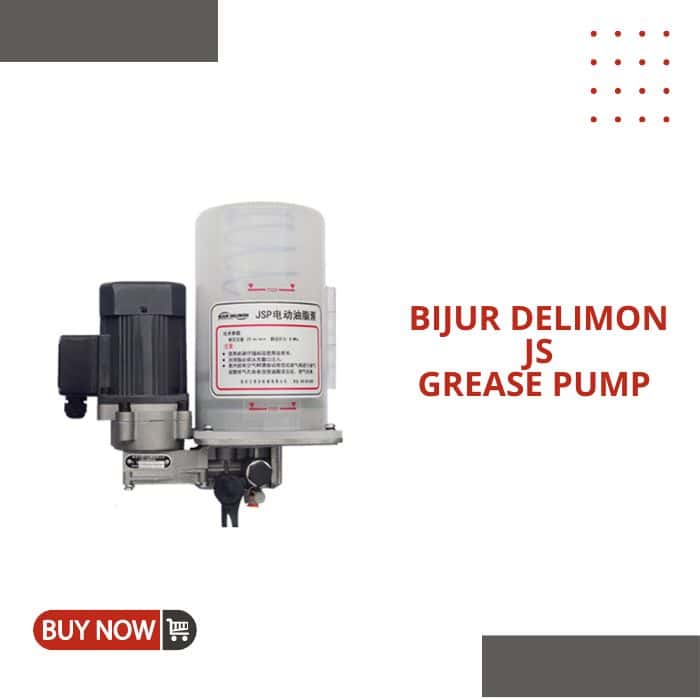
BIjur delimon JS grease pump
$ 95.66
Save (85%)
Bijur Delimon JS Series Electric Grease Pump The Bijur Delimon JS series electric grease pump is a compact, piston-driven centralized lubrication pump designed for integration into single-line resistance (SLR) and progressive (PRG) grease systems on industrial machinery, machine tools, and light commercial equipment. Driven by a DC or AC electric motor, it delivers consistent, metered grease output under PLC or external controller command — no manual lubrication cycles required during machine operation. The JS series is available in two variants: the JS (pump unit only, requiring an external progressive distributor or SLR control unit) and the JSP (pump with integrated progressive distributor block, providing a more compact all-in-one installation). Reservoir capacities of 0.5L, 1L, 1.5L, and 2L cover a range of lubrication point counts and service interval requirements. Technical Specifications Parameter Specification Rated Working Pressure 10 MPa (100 bar / 1,450 PSI) Maximum Output 25 ml/min Reservoir Volume 0.5L / 1L / 1.5L / 2L Motor Voltage Options 12V DC / 24V DC / 220V AC / 380V AC Grease Grade NLGI 000 to NLGI 1 (standard); low-temperature grease for operation below −10°C Lubricating Oil Viscosity 32–320 mm²/s (cSt) Operating Temperature −20°C to 60°C Outlet Thread NPT 1/8″ Drive Type Electric piston pump (DC or AC motor) Control Interface External controller or PLC (not included) Overpressure Protection Integrated overflow/relief valve JS vs JSP — Model Variants Explained Variant Configuration Best For JS Pump unit only — connects to external progressive distributor block or SLR control unit Systems where the distributor block is already installed or mounted remotely; larger installations requiring a separate, larger-capacity distributor JSP Pump with integrated progressive distributor — compact all-in-one unit New installations where space is limited; machines with up to 8–12 lubrication points where a combined unit simplifies installation and wiring Part Number Guide The JS/JSP part number encodes reservoir size, voltage, and controller option. The structure is: [Series]-[Reservoir]-[Voltage]-[Controller] Field Code Meaning Series JS Pump only (external distributor required) Series JSP Pump with integrated progressive distributor Reservoir G1 1L reservoir Reservoir G2 2L reservoir Voltage D2 24V DC Voltage A2 220V AC Controller C With integrated controller Controller (none) Without controller — requires external PLC or timer Available part numbers: JS-G1-D2-C, JS-G2-D2, JSP-G1-D2, JSP-G1-D2-C, JSP-G2-A2-C Contact us to confirm availability and specify your required reservoir size, voltage, and controller option. How It Works The JS pump uses a piston discharge mechanism driven by an electric motor. On each motor cycle, the piston displaces a metered volume of grease from the reservoir into the outlet circuit. The integrated overflow valve protects the distribution system from overpressure — if outlet pressure exceeds the rated 10MPa, the valve opens and redirects grease back to the reservoir rather than allowing pressure to build beyond the system’s rating. The pump is activated by an external controller or PLC signal. A timer-based controller triggers lubrication cycles at fixed intervals; a PLC can trigger cycles based on machine operating state, load signals, or production counts. The pump does not include an internal controller unless the “-C” suffix is specified in the part number. In a JSP configuration, grease exits the pump directly into the integrated progressive distributor, which sequences output to each outlet port in a fixed cycle — every connected lubrication point receives its dose before the cycle repeats. A cycle indicator pin on the distributor confirms system operation and can trigger a fault signal to the PLC if the cycle does not complete within a set time. Typical Applications The JS/JSP series is well suited to light and medium industrial machinery requiring centralized automatic lubrication with a compact pump footprint: CNC machine tools — slideway, ballscrew, and spindle bearing lubrication on machining centres and lathes where a compact pump mounts inside the machine cabinet Packaging and food processing machinery — conveyor chain drives, cam followers, and crank bearings requiring regular grease doses during production cycles Printing and paper-handling equipment — roller bearings, guide rail slides, and paper feed mechanism pivot points Light conveyor systems — idler bearing lubrication on assembly line conveyors and sorting systems Textile and fabric machinery — high-cycle cam and bearing lubrication in weaving and knitting equipment Retrofit lubrication — replacing worn or failed Bijur Delimon JS-type pumps in existing centralized lubrication installations without modifying outlet connections or distribution lines System Compatibility The JS series pump is compatible with: Single-line resistance (SLR) systems — connect the pump outlet to an external SLR control unit; both outlets can be used simultaneously in SLR configuration Progressive (PRG) systems — connect to an external or integrated progressive distributor block; in PRG mode, use a single outlet only NLGI 000 and NLGI 1 greases — standard for most centralized lubrication systems on light industrial equipment; confirm grease grade before filling Lubricating oils at 32–320 mm²/s viscosity for combined grease/oil system applications For compatible progressive distributor blocks, see our grease distributor blocks range. For high-pressure hose and fitting connections, see our high-pressure hoses. Installation Notes Mount the pump in a position accessible for reservoir refilling — the fill port must be reachable without removing the unit from its mounting bracket Connect the motor supply through a dedicated fuse sized to the motor’s rated current; do not share the pump supply circuit with high-inrush loads For 24V DC installations on mobile equipment, add a voltage surge suppressor rated to 100V/1s load dump between the vehicle electrical system and the pump motor Connect the outlet fitting to NPT 1/8″ female thread using the appropriate compression fitting or hose end; apply thread sealant (PTFE tape or anaerobic compound) to the male thread before assembly Prime the pump and distribution lines by running several lubrication cycles into a waste container before connecting to bearing housings — this purges air from the circuit and confirms grease flow before the system goes into service For JSP units, verify that the progressive distributor completes a full cycle indicator movement after each pump actuation sequence, confirming all outlet ports have received grease FAQ What is the difference between the JS and JSP models? The JS is a pump-only unit that requires connection to an external progressive distributor block or SLR control unit to distribute grease to multiple lubrication points. The JSP integrates the pump and a progressive distributor block into a single compact unit, simplifying installation and reducing the number of separate components and connections. Choose the JS when connecting to an existing or remotely mounted distributor; choose the JSP for new installations where a self-contained unit is preferred. What do the codes in the part number mean? The part number encodes four parameters: series (JS = pump only, JSP = pump with integrated distributor), reservoir size (G1 = 1L, G2 = 2L), voltage (D2 = 24V DC, A2 = 220V AC), and controller option (C = with integrated controller, no suffix = external controller required). For example, JSP-G1-D2-C is a pump with integrated distributor, 1L reservoir, 24V DC motor, and built-in controller. Does the pump include a controller? Only models with the “-C” suffix in the part number include an integrated controller. Models without the “-C” suffix require an external timer-based controller or PLC to trigger lubrication cycles. The controller or PLC is not included with any JS/JSP pump regardless of suffix — the “-C” suffix indicates an integrated electronic control board built into the pump housing, not a separate external unit. What grease grades are compatible? The JS/JSP series is designed for NLGI 000 and NLGI 1 grease — grades commonly used in centralized lubrication systems on machine tools and light industrial equipment. NLGI 2 grease is not recommended for this pump series; its higher consistency exceeds the pump’s rated viscosity handling at standard operating temperatures and may cause insufficient flow to the pump inlet. For operation below −10°C, specify a low-temperature formulation within the NLGI 000–1 range with adequate low-temperature flow properties. Is the JS pump a direct replacement for existing Bijur Delimon JS installations? Yes. The Isohitech JS/JSP series is manufactured to the same functional specification as Bijur Delimon JS-type pumps and is compatible with existing centralized lubrication systems using NPT 1/8″ outlet connections. Before ordering, confirm the reservoir size, voltage, and controller configuration of the unit being replaced by referring to the part number on the existing pump’s nameplate. Can the pump be controlled by a PLC? Yes. The JS/JSP pump accepts a 24V DC digital signal from a PLC output to trigger each lubrication cycle. The pump can also provide a fault output signal (from the distributor cycle indicator on JSP models) back to a PLC digital input for monitoring. Confirm the specific control wiring requirements for your pump model when ordering, as input/output terminal configurations vary between JS and JSP variants and between controller and non-controller versions. Ordering information: specify your required variant (JS or JSP), reservoir size (0.5L, 1L, 1.5L, or 2L), motor voltage (12V DC, 24V DC, 220V AC, or 380V AC), and controller option — our team will confirm the exact part number, availability, and EXW Nanjing pricing. Related: Grease Pump hub — types, selection guides, and troubleshooting.
Related products
-
47%
-
45%
-
42%